


Rochelle-Leigh (Shelley) Rosenberg “I don’t think they will ever reinvent the wheel. And the difference between this moment until the moment of reaching an agreement will be how many names–Palestinians and Israelis–will be added to the lists of death and agony. At the end of the day, there will...
Here is the place to review the fantastic HNLR Symposium 2012! A written recap and pictures will here shortly, but to keep you die-hards busy here are the links to the videos of the event: Quantitative and Qualitative Methods of Evaluating ADR ADR in the Criminal Justice System Co-optation of...
It’s hard to believe that we’re already into February 2012. But, as Colum McCann would say, the great world spins on, and with it comes ADR news. Over at the New York Times, Gretchen Morgenson opines on why a $1.38 million arbitration award still didn’t satisfy one bitter investor. Any...
ADR and college football: In the course of its struggle to free itself from the Big East conference, West Virginia University finds itself ordered to engage in non-binding mediation with conference reps. Same ADR process, very different context: The Department of Justice hopes that mediation can serve as a foreclosure...
An able negotiator knows that a crucial step in entering any negotiation is understanding when to break off negotiations i.e., knowing your BATNA (Best Alternative To a Negotiated Agreement). To discover your BATNA, you must first determine your reservation value. Your reservation value is the lowest value at which you...
Hello Dedicated Readers, In case somehow you have not heard the news, I will inform you of the recent events in Geneva. In brief, States from across the globe gathered in Geneva to negotiate a multi-lateral international agreement regarding Cluster Munitions. The basic mechanism of Cluster Munitions is that a...
By Matthew Parker, a 3L law student at Harvard Law School I. Introduction: The Role of Culture in Email Negotiations Culture fundamentally affects email negotiations. In an increasingly globalized world where cross-border negotiations have increased substantially[1] and the use of email communication has grown exponentially,[2] surprisingly little research, however, has...
With a divided government and the election of many legislators on platforms of “no compromise,” is there any hope that the next Congress will accomplish anything meaningful to address the multitude of challenges facing the nation?
Bargaining with the Devil, to Robert Mnookin, means negotiating with someone who has intentionally done harm and may well do so in the future: “an adversary whose behavior [one] may even see as evil.” 1 Should one negotiate with such a person or such a regime? Surprisingly, in this book, the Chair of Harvard’s Program on Negotiation argues that there are circumstances in which the wise decision is to fight the harm-doer rather than negotiate. But that decision, if it is truly wise, can be made only after a rigorous analysis of the situation. In this book Mnookin sets out a framework to help in that analysis and illustrates it by reference to eight case histories. The question posed by the book’s sub-title is stark: when to negotiate, when to fight?
By Peenesh Shah* I. Introduction Under Section 7 of the Federal Arbitration Act, arbitrators are empowered to subpoena third parties. When a subpoenaed third party objects, however, courts are enlisted to resolve the objection—and, when appropriate, to enforce the subpoena. Should these courts allow arbitrators to manage such disputes at...
Negotiation, not adjudication, resolves most legal conflicts. However, despite the fact that dispute resolution is central to the practice of law and has become a “hot” topic in legal circles, a gap in the literature persists. “Legal negotiation” — negotiation with lawyers in the middle and legal institutions in the background — has escaped systematic analysis.
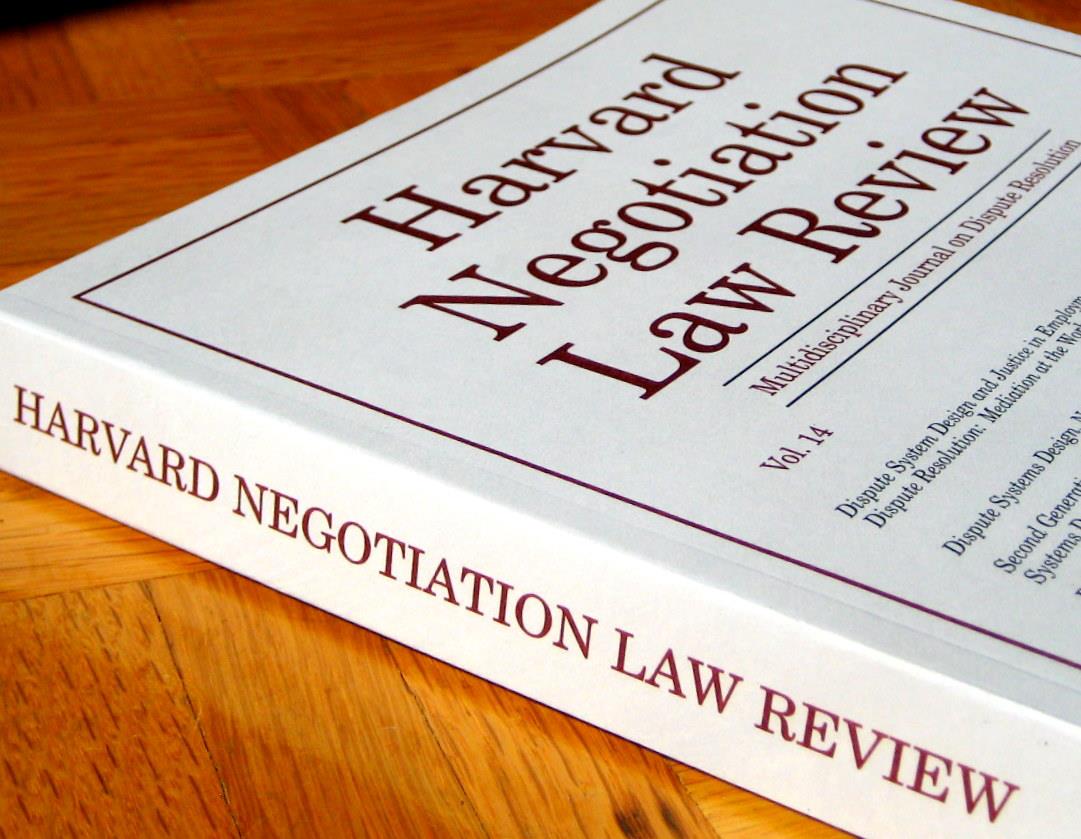
The Harvard Negotiation Law Review works to close this gap by providing a forum in which scholars from many disciplines can discuss negotiation as it relates to law and legal institutions. It is aimed specifically at lawyers and legal scholars. In its 18 year history, the journal has explored interdisciplinary academic perspectives on such topics as decision analysis; litigation settlement; mediator roles, strategies and tactics; the lawyer’s role as a problem solver; reconsideration of legal education in light of negotiation; and a range of case studies of innovative negotiation and mediation systems around the world.